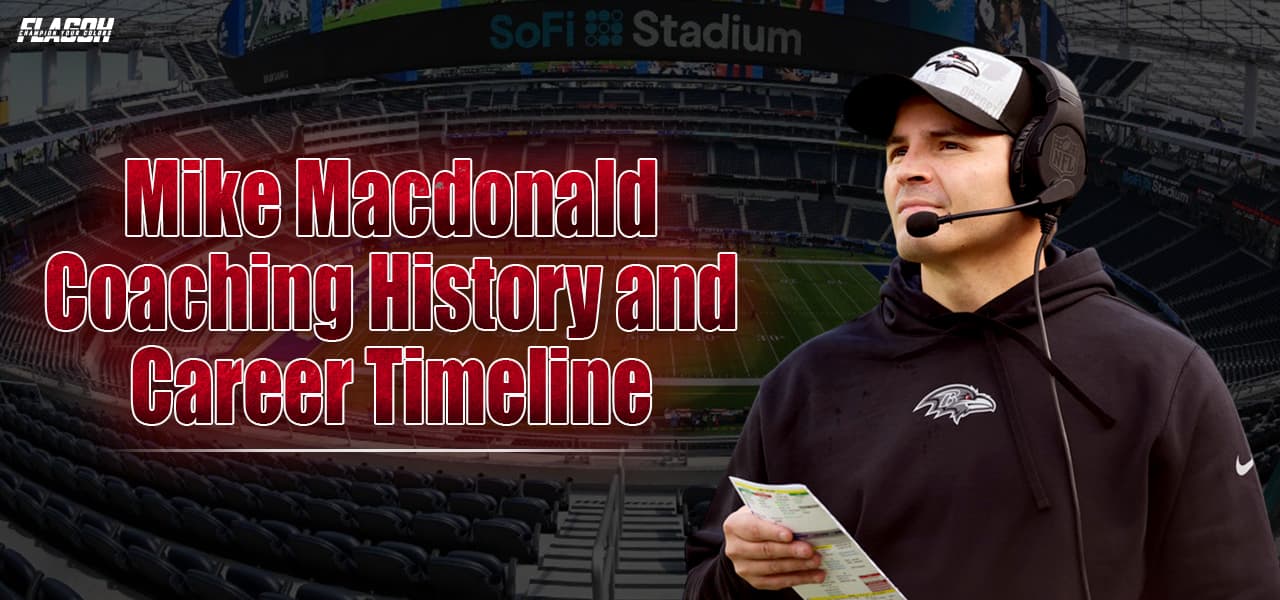
Mike Macdonald coaching history is best understood through a clear, season-by-season timeline that shows where he coached, his official role, and the unit he led. This guide presents a verified year-by-year record, followed by a brief context on defensive style and results.
Coaching Background and Career Overview
This overview gives the quick background on Mike Macdonald, what this coaching history covers, and how we verify roles and dates before the year-by-year timeline.
Who Mike Macdonald Is Today
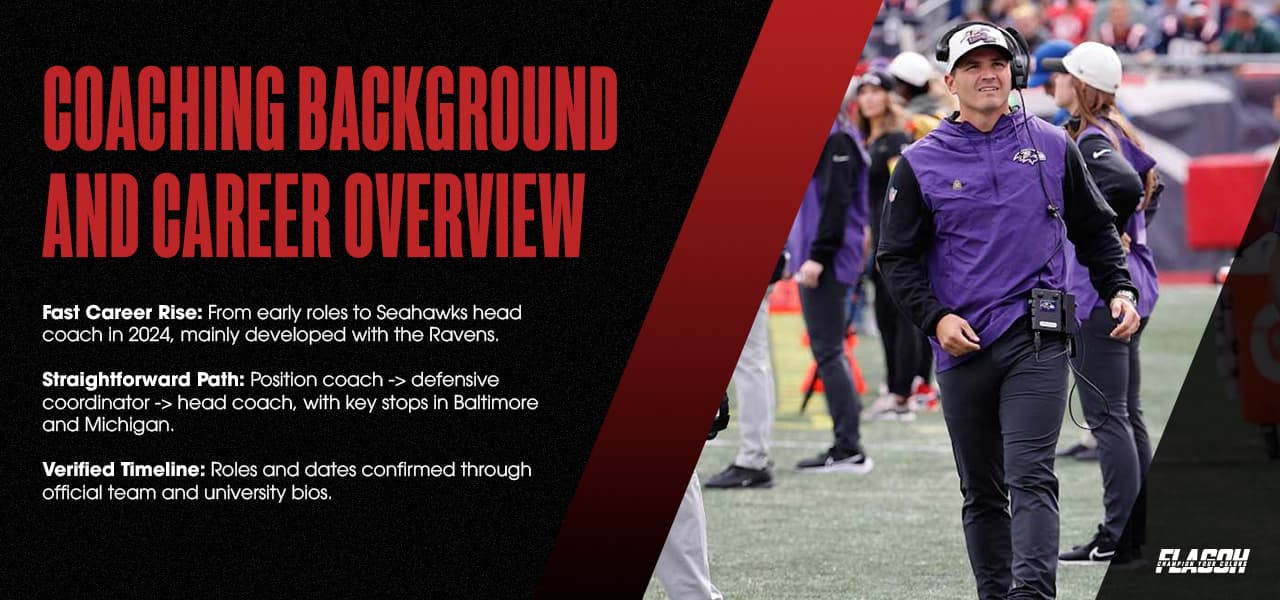
Mike Macdonald is the head coach of the Seattle Seahawks. His coaching history is best understood as a year-by-year progression from early roles at Cedar Shoals High School and Georgia, to a long development path in Baltimore, one season as Michigan’s defensive coordinator, and then a return to the Ravens as defensive coordinator before becoming Seattle’s head coach.
This page focuses on a verified season-by-season timeline of his roles and responsibilities, with key defensive results added only where they can be tied to official team or university sources. It is structured so readers can quickly confirm dates first, then go deeper on the scheme and results.
What This Coaching History Covers
Most readers want a clean year-by-year path, clear role definitions, and a grounded way to connect style to results. The sections below follow that same order, so you can scan first, then go deeper when you want.
This article is built to answer those needs in the same order people search for them.
How We Verify Roles and Dates
To keep the timeline accurate, use a simple source ladder. Start with official team and university coach bios for the core year-by-year role list, then use official recaps, gamebooks, or season stats pages to add performance context.
For Macdonald, the Seahawks and Michigan coach bios are the most reliable starting points for titles and sequence. In some periods, one source may use a broader title while another provides a more specific role description for the same years. When that happens, keep the official wording in the timeline row and use the notes column to clarify details only when they are documented.
Year-by-Year Coaching Timeline
A season-by-season view makes the career path easy to follow and shows how responsibilities changed over time.
What Each Timeline Entry Shows
Each timeline entry lists the season, team, official title, and primary unit to show how Macdonald’s responsibilities changed over time. For Seattle, the head-coach years should be tracked by individual season rather than grouped as “present,” so readers can separate the hire date from year-by-year outcomes.
This format avoids a common mistake in coaching timelines: treating one title as if the responsibilities and context stayed the same across multiple seasons. A position coach usually owns one group and its fundamentals, while a coordinator or head coach role carries broader weekly planning and team-level responsibility.
A Simple Year-By-Year Template
Below is a copy-ready timeline you can scan in seconds.
| Season | Team | Role | Unit | Quick note | Best source |
| 2008–2009 | Cedar Shoals HS | LBs and RBs coach | Defense and offense | Early coaching start | Seahawks bio |
| 2010 | Georgia | Student assistant | Staff | Entry-level college role | Seahawks bio |
| 2011–2013 | Georgia | Graduate assistant | Staff | GA years before NFL | Seahawks bio |
| 2014 | Baltimore Ravens | Defensive coaching intern | Defense | First NFL role | Seahawks bio |
| 2015–2016 | Baltimore Ravens | Defensive assistant | Defense | Support role on staff | Seahawks bio |
| 2017 | Baltimore Ravens | Defensive backs coach | Defense | Position coach | Seahawks bio |
| 2018–2020 | Baltimore Ravens | Linebackers coach | Defense | Position coach | Seahawks bio |
| 2021 | Michigan | Defensive coordinator | Defense | College DC season | Seahawks bio |
| 2022–2023 | Baltimore Ravens | Defensive coordinator | Defense | NFL DC seasons | Seahawks bio |
| 2024 | Seattle Seahawks | Head coach | Team | First season in Seattle (hired Jan. 31, 2024) | Seahawks bio / Seahawks coach profile |
| 2025 | Seattle Seahawks | Head coach | Team | Second Seattle season (add one verified season outcome note) | Official Seahawks season recap/team coverage |
| 2026–present | Seattle Seahawks | Head coach | Team | Current status (update each offseason) | Seahawks coach profile page |
If you expand this into a series, each stop can link to a deeper page on scheme, staff, or season context.
Handling Title Changes And Shared Duties
Timelines get messy when job titles shift slightly across organizations or when responsibilities are assumed rather than documented. The safest approach is to keep the official title exactly as it appears in the team bio, then use your notes column only for details you can point to clearly. If you want to add labels like play-caller or primary responsibility, do it only when the team or credible reporting states it directly, and keep the wording neutral. That way, the timeline stays clean, readable, and easy to update without turning into speculation.
It also makes later scheme notes and stat comparisons easier to follow.
Defensive Style and Scheme Over Time
Here’s a simple way to understand the defensive approach and how it evolved across different stops, using the clear breakdown style we use at FlagOh Fanatics.
Simple Scheme Basics Fronts Coverages and Pressure
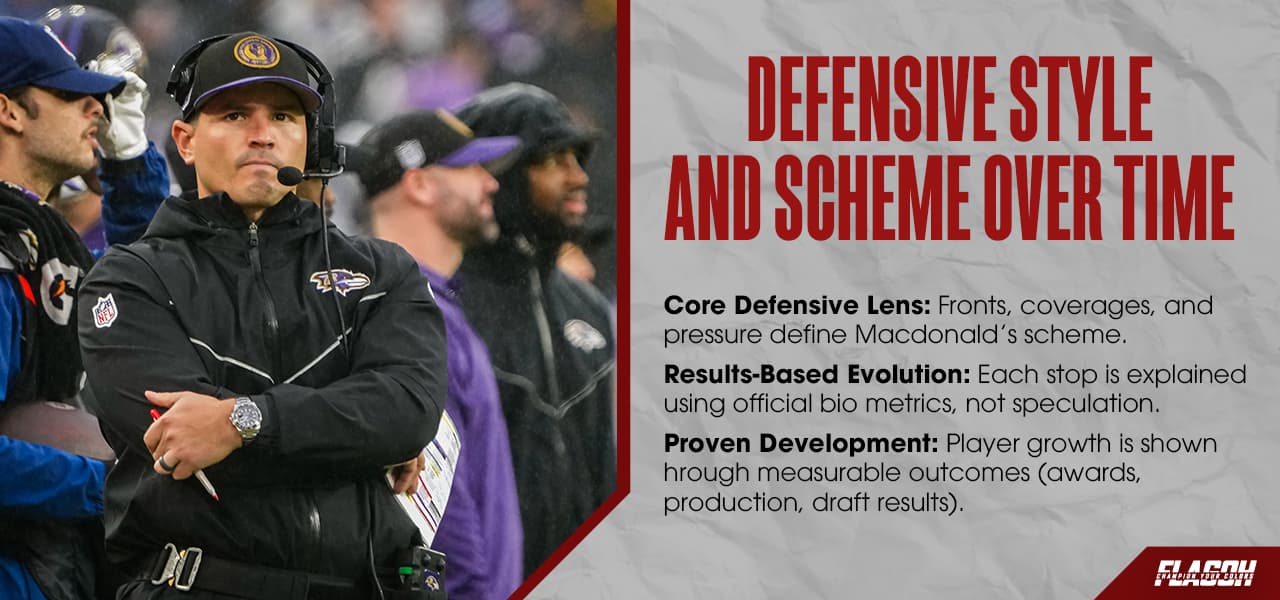
Macdonald’s defenses are typically evaluated through three consistent elements: front structure, coverage tendencies, and pressure usage. These provide a simple framework for comparing results across teams and seasons.
Scheme Changes by Team and Season
Rather than guessing exact fronts or coverages for every year, a more trustworthy way to describe scheme evolution is to anchor it to what official sources confirm and what performance indicators suggest.
From the Seahawks coach bio, Macdonald’s 2023 Ravens defense is described with specific outcome markers, including points allowed 16.5 PPG, 60 sacks, and 31 takeaways, along with top rankings across several categories.
For 2022, the same bio lists rankings and unit stats like 18.5 PPG, 92.1 rushing YPG, and percentage-based situational defense results such as third-down defense 34.9% and red zone defense 46.4%.
For 2021 Michigan, the bio lists 17.4 PPG and other defensive measures that help frame the season.
Use those as your “era cards” structure:
- Stop and season
- What the official bio states
- What metric category improved
- One sentence of context that you can verify
Player Development Signs You Can Measure
Player development is often overclaimed, so keep it measurable. Good signals include:
- Awards and honors
- Draft outcomes
- Role expansion over time
- Production jumps that match a new role
The Seahawks bio highlights Michigan DE Aidan Hutchinson’s standout 2021 season under Macdonald, including 14 sacks and major national recognition. That’s the kind of “development note” that is safe to include because it is specific and attributed.
That scheme context makes the results easier to read, so the next section moves into consistent metrics.
Defense Results and Key Metrics Explained
Numbers make the story easier to compare, so this section uses a small set of stats that stay clear and consistent across seasons.
The 3–4 Metrics That Travel Well
If you want a simple “comparison pack” that works across NFL and college seasons, start here:
- Points allowed per game PPG
- Yards allowed per play YPP
- Takeaways or takeaway rate
Those three are widely understood and easy to cite from official stats pages. When you want a fourth, add a situational metric like third-down defense percentage or red-zone defense percentage, which the Seahawks bio also lists for 2022.
Before and After Defense Snapshot
A clean before-and-after snapshot works best when you compare the same stat types one season before and one season after, then add one short context line so totals do not get misread.
This prevents the classic mistake where fans compare raw totals across different schedule lengths or eras.
How to Compare Across Different Seasons
To keep comparisons fair, prioritize rates over totals, note season length differences, and avoid attributing every change to one coach when roster health and context shifted.
If you want to be extra clear, add a small “limitations” box that says: “Stats describe results, not certainty about causes.”
These metrics give a fair snapshot while leaving room for context, which helps you avoid overconfident conclusions.
Coaching Tree and Defining Moments Guide
Mike Macdonald coaching history becomes clearer when you add the people he learned from and the moments that shaped how fans remember his defenses.
Mentors and Staff Connections
Mike Macdonald’s coaching history becomes easier to understand when it is anchored to the head coaches and staffs he worked under during his most formative years. Rather than mapping an oversized “coaching tree,” this section focuses on documented staff connections that clearly shaped his responsibilities and opportunities.
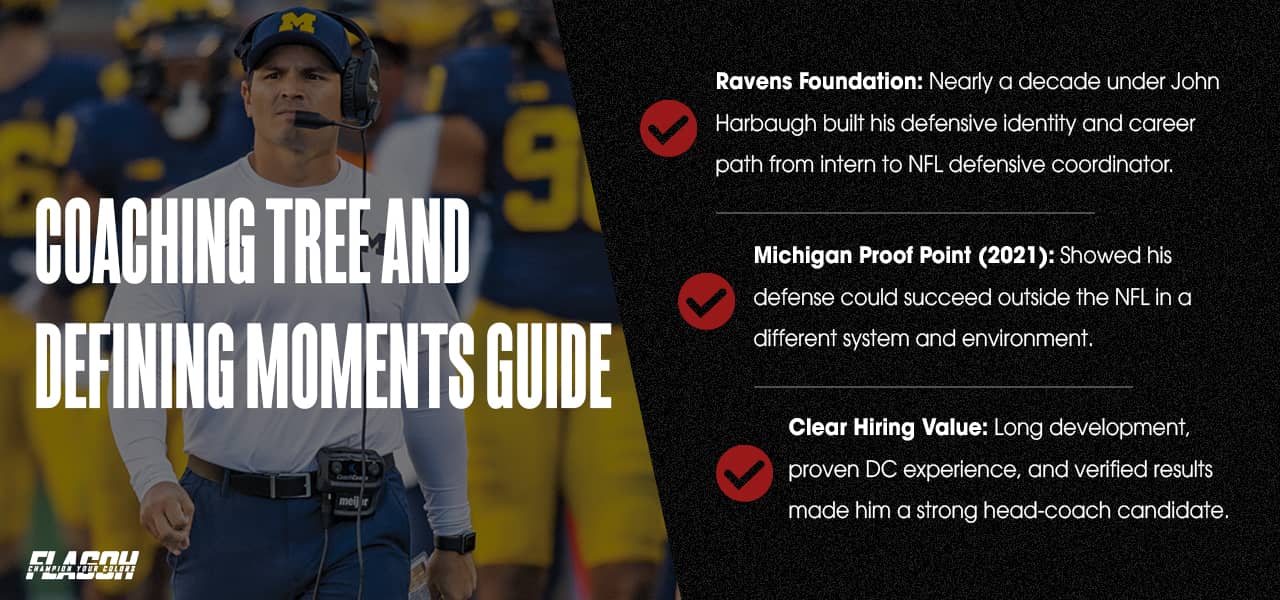
The most significant and verifiable influence on Macdonald’s career came from his extended tenure with the Baltimore Ravens under John Harbaugh. Macdonald spent nearly a decade in the Ravens organization, progressing from defensive intern to position coach and eventually defensive coordinator. That extended runway inside one NFL system provided continuity in defensive philosophy, weekly preparation standards, and organizational expectations.
A second defining stop came in 2021 at Michigan, where Macdonald served as defensive coordinator under Jim Harbaugh. That season offered a clear proof point outside the NFL, showing that his defensive approach could translate to a different roster, ruleset, and competitive environment while still producing top-tier results.
Beyond those two anchors, any broader “coaching tree” should be built cautiously. The most reliable approach is to reference confirmed staff overlap and official bios, rather than speculating about indirect influence. Framing staff connections this way keeps the coaching history accurate, readable, and easy to update as new seasons add context.
Defining Games
If you want defining moments without overclaiming, use a simple game-log format and choose games that match clear criteria (playoff setting, top offense faced, or a high-leverage divisional matchup). This is a research template by design: fill each row only after you have a citable box score, gamebook, or official recap.
| Season | Opponent | Result | Key stat | Proof |
| 2023 | Fill in | Fill in | Fill in | Box score or gamebook |
| 2022 | Fill in | Fill in | Fill in | Box score or gamebook |
| 2021 | Fill in | Fill in | Fill in | Official recap or box score |
This table stays honest because it tells readers exactly how to verify the picks.
Why Teams Hired Him and What They Expected
A practical way to explain hiring expectations is to tie it to documented outcomes and role progression:
- Long runway inside the Ravens system
- One-year college DC proof point
- Two NFL DC seasons before becoming a head coach
That progression is explicitly supported by the official career listings.
Putting mentors, key games, and hiring expectations side by side helps the career arc feel complete without leaning on guesswork.
Quick Answers for Common Questions
These quick questions cover the most common things readers want to confirm at a glance, from teams and roles to the key career milestones.
What is Mike Macdonald’s current role?
He is the head coach of the Seattle Seahawks. In timeline format, it is best to track his Seattle tenure by season so readers can separate the 2024 hire date from later year-by-year results.
How should coaching titles be verified when sources use different wording?
Start with official team or university coach bios for the core role list, then use a notes field for documented clarifications. Keep the timeline title wording official whenever possible, and avoid adding unofficial labels unless they are directly supported.
What is Mike Macdonald’s coaching timeline?
It is the year-by-year record of where he coached and what role he held, from early roles at Georgia and the Ravens through defensive coordinator jobs and then head coach in Seattle.
What teams has Mike Macdonald coached for?
He has coached for Cedar Shoals High School, the University of Georgia, the Baltimore Ravens, the University of Michigan, and the Seattle Seahawks.
What roles has Mike Macdonald held in his coaching career?
His roles include high school position coach, Georgia student assistant and graduate assistant, Ravens defensive intern and defensive assistant, Ravens defensive backs coach and linebackers coach, Michigan defensive coordinator, Ravens defensive coordinator, and Seahawks head coach.
When did Mike Macdonald become a defensive coordinator?
He was Michigan’s defensive coordinator in 2021 and later served as the Ravens defensive coordinator in 2022–2023.
Where did Mike Macdonald coach before becoming a head coach?
Before becoming the Seahawks head coach, he coached primarily with the Ravens organization, with one season as Michigan’s defensive coordinator in 2021, and then returned to the Ravens as defensive coordinator in 2022–2023.
If you still have a specific season or role in mind, the timeline above is the fastest place to double-check it before digging deeper.
If you came here for Mike Macdonald’s coaching history, you now have a verified timeline and a consistent way to read roles, scheme context, and defensive results. Save this page as a reference and revisit it on FlagOh Fanatics as new Seattle seasons add context to the coaching timeline.