
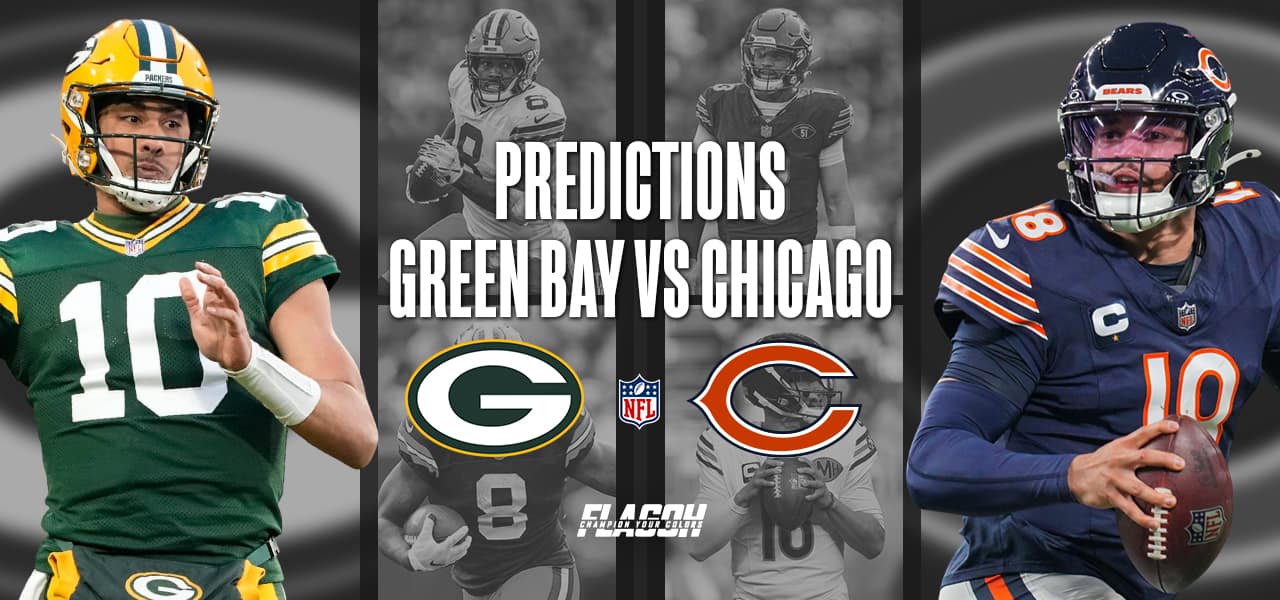
December at Soldier Field is a conditions game. These Green Bay vs Chicago predictions start with the market lean, validate it with drive efficiency, then use late wind and injury news to confirm (or flip) the bet—the same structured approach FlagOh Fanatics uses for rivalry previews.
How We Build Our Green Bay vs Chicago Predictions
Predictions at a Glance (as of 3:30 PM CT): odds from a live screen, injuries from the official report (DNP/LP/FP), and wind from hourly Soldier Field forecasts. Re-check close to kickoff to avoid stale lines.

- Lean (Spread): Packers -1.5 — Medium
- Lean (Total): Under 46.5 — Medium
- Projected score: Packers 24, Bears 22
- What would change it: Wind stays under ~10 mph with a late CB scratch, or either team loses a key pass rusher close to kickoff.
We use a simple checklist: if the edge depends on one fragile assumption, we pass.
A Three-Layer Strategy That Prevents Betting Mistakes
- The Problem: Most bettors pick a team first, then cherry-pick stats to support that feeling.
- The Agitation: In a divisional rivalry, that’s how you get fooled by recency bias or a single highlight play from last week. You might bet the Bears just because they are home, ignoring that the cold plus wind can compress the passing game and shrink the margin for error.
- The Solution: We invert the process: start with the market’s baseline, validate it with drive-level efficiency, then adjust for late variables like injuries and wind that can change everything.
The Efficiency Metrics We Trust More Than Total Yards
We prioritize metrics that translate to points and possessions:
- Implied score (spread/total): The market baseline.
- Red-zone TD rate: Finish with 7 or settle for 3.
- Pressure-to-sack rate: Drive-killing negatives and turnover risk.
- Recent form window: The last 4–6 weeks, more than September.
How to use this: if your pick depends on a single highlight or a season-long yardage rank, you’re probably overfitting.
Layer 1 Decoding the Betting Market
Before analyzing matchups, we decode the odds to cut through the rivalry hype—this is the same framework FlagOh Fanatics uses to keep rivalry previews structured and repeatable. This market read turns the line into an implied score and highlights movement that’s typically tied to injuries or confirmed weather shifts.
Calculating the Implied Score from the Odds
Here is the clean way to “translate” what Vegas is telling you. Quick math: Favorite = (Total ÷ 2) + (Spread ÷ 2). Underdog = (Total ÷ 2) − (Spread ÷ 2).
With Green Bay hovering around -1.5 and the Total at 46.5, the math is simple:
- Favorite (Packers): ~24.0 points
- Underdog (Bears): ~22.5 points
What this means for you: At -1.5, this is essentially a one-possession game with Green Bay slightly favored. If you bet the Packers, you are betting on their efficiency to hold up on the road. If you bet the Bears, you’re usually projecting a swing factor—turnovers, special teams, or a few explosive plays—to decide a one-score game.
Interpreting Key Line Movement Signals
Line movement matters most when it’s tied to two things: Injury Information (especially O-Line or Pass Rush) and Weather Shifts.
- The Trap: Early-week content ages fast. If you see a “Packers Lock” article from Tuesday, but a key pass rusher is ruled out on Saturday, that lock is now a liability.
- Weather matters, but don’t chase early-week forecasts—use the Soldier Field Wind Rule in Layer 3 once you have hourly data on game day.
Week 16 Prediction Snapshot Overview
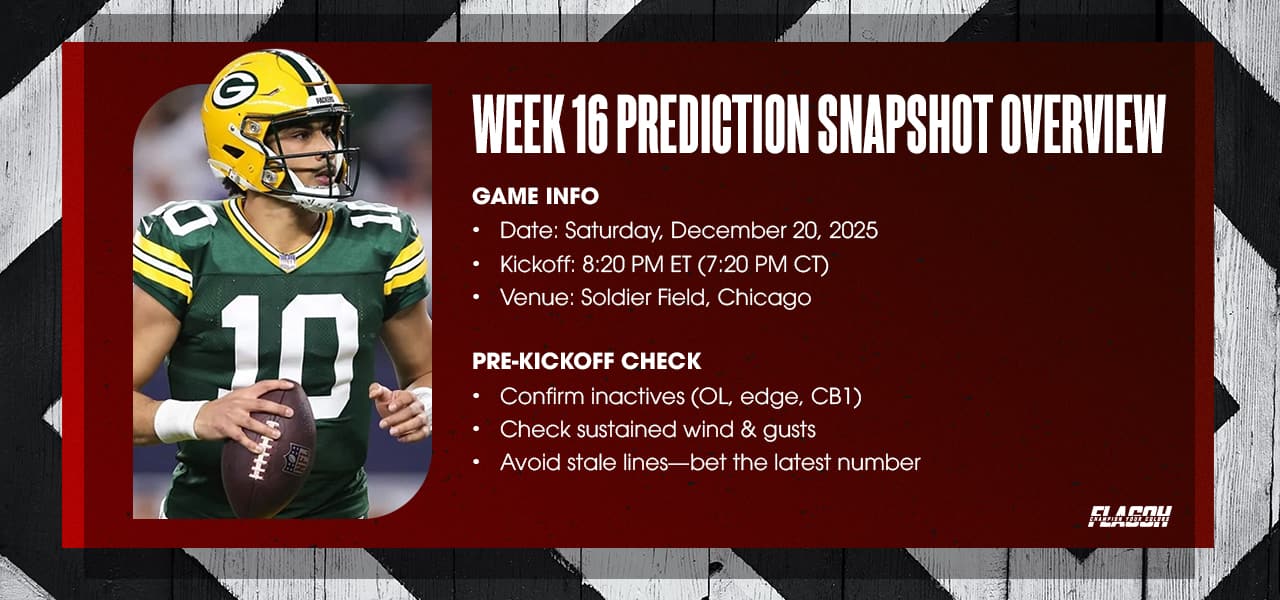
Game info:
- Date: Saturday, December 20, 2025
- Kickoff: 8:20 PM ET (7:20 PM CT)
- Venue: Soldier Field, Chicago
Game-day check (60–90 minutes before kickoff):
- Confirm inactives (especially OL, edge rush, CB1).
- Check sustained wind + gusts (mph), not just temperature.
- Compare your bet to the latest number—don’t bet stale lines.
Snapshot is based on the market as of 3:30 PM CT. Re-check the number and inactive close to kickoff.
| Market | Current Lean | Confidence | Why | Avoid / Wait If… |
| Spread | Packers -1.5 | Medium | Tight market; finishing edge matters in one-score games | Key pass rushers ruled out late |
| Total | Under 46.5 | Medium | Rivalry familiarity + conditions can compress explosives | Wind stays <10 mph, or secondaries are compromised |
| Moneyline | Packers (approx. -125) | Low–Med | Thin edge; comes down to high-leverage snaps | No clear turnover/pressure thesis |
Layer 2 Examining Core Matchup Efficiency
Drive Efficiency Metrics That Predict Scoring
For accurate Green Bay vs Chicago predictions, we look at the “Life Cycle” of a drive:
- Early Downs: Can you stay ahead of the chains?
- 3rd Down: Can you extend the drive?
- Red Zone: Do you settle for 3 or get 7?
Season-to-date, Green Bay is scoring TDs on 64.71% of red-zone trips (TD only) versus Chicago at 59.18%. In a one-score spread, that often shows up as 7 vs. 3.
One wrinkle: over the last three games, Chicago has been the better finisher (63.64% vs. 57.14%), so treat this edge as smaller than the full-season number.
QB Under Pressure: Love vs. Williams
Pressure does three things that swing spreads: it creates negative plays (sacks), kills drives, and causes turnovers. Quick check: compare each offense’s pressure allowed rate and each defense’s pressure generated rate over the last 4–6 games. If one side has a clear edge, that’s often the cleanest “why” behind a spread lean.
- Green Bay: If the pass-rush rotation is compromised on the final injury report, Chicago’s dropback plan becomes cleaner—and that can raise both explosive-play odds and live-betting volatility.
- Chicago: When the pocket collapses, Williams is more likely to extend plays—great for explosives, but it can also raise sack and turnover risk if pressure arrives without a blitz.
Explosive Play Potential Against Defensive Coverage
Unders are fragile. All it takes is two broken coverages to ruin a “defensive struggle” bet. Ask yourself: “Do these teams have easy explosive paths today?”
Right now, Green Bay’s defense plays a “shell” designed to prevent deep shots. Unless the Bears can run the ball efficiently to suck the safeties down, the big plays shouldn’t be there.
Layer 3 Evaluating Trenches Pace and Critical Conditions
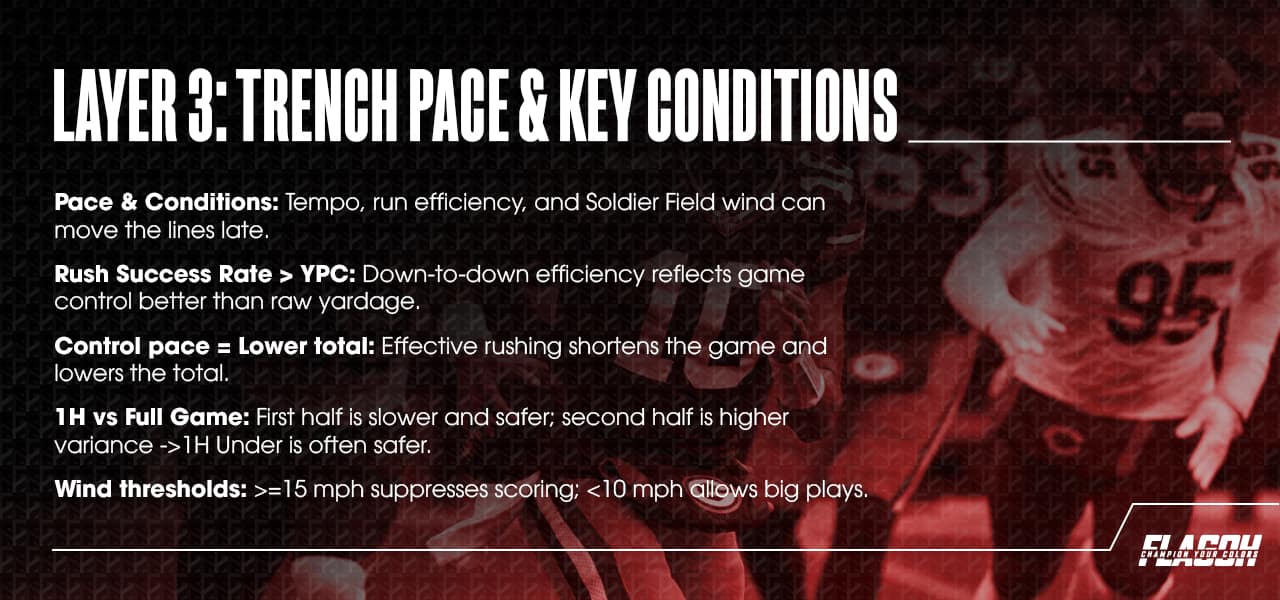
This layer is about pace and conditions—run success, game script, and Soldier Field wind—where totals and spreads swing late.
Why Rush Success Rate Matters More Than Yards Per Carry
Yards per carry can be noisy, so success rate is usually a better signal for down-to-down sustainability. Instead, look at Success Rate (gaining 40% of yards on 1st down, 60% on 2nd, etc.). That’s a down-by-down benchmark (40/60/100) that better reflects drive sustainability than raw YPC.
When a team has a high rush success rate, they control the clock. This drains possessions and naturally lowers the game total—even if they aren’t breaking 50-yard runs. If the Packers can grind out 4-yard runs on 1st down, they will shorten the game significantly.
Contrasting First Half Strategy with Full Game Pace
- First Half: Usually scripted and conservative, especially in the cold.
- Second Half: Where variance spikes—tempo, short fields, and desperation drives can swing both spread and total.
If you like the “Under,” the First Half Under is often safer. Late-game desperation drives, prevent defenses, and turnovers can blow up a full-game total in the final 4 minutes.
The Critical Impact of Wind Thresholds on Scoring
Soldier Field Wind Rule
- If sustained wind is around 15 mph or higher, deep passing and long kicks tend to get less efficient, and coaches become more conservative on borderline decisions.
- If the wind is under about 10 mph, the total becomes more vulnerable to a couple of explosives.
- Use hourly wind data on game day when possible.
Final Best Bets and Essential Game Day Gear
Analysis means nothing without execution. We’ve distilled our Green Bay vs Chicago predictions into a cheat sheet of sharp bets and correlated props, along with the essential gear you need for kickoff.
A Cheat Sheet for Smart Betting Scripts
- The “Packers Control” Script: If Green Bay’s pass rush is healthy, bet Packers -1.5.
- The “Grind It Out” Script: If the wind is high (>15mph), bet Under 46.5.
- The “Safety” Rule: If your bet relies on a “Questionable” player, wait. Protecting your bankroll is better than guessing.
Constructing Correlated Player Props and Parlays
Build parlays that tell a story. Don’t bet on “Packers to Win” AND “Caleb Williams 300+ Passing Yards.” Those contradict each other.
Correlated Play: Packers Moneyline + Josh Jacobs Rushing Yards + Under Total. This assumes Green Bay wins by controlling the clock on the ground.
Selecting Durable Materials for Outdoor Rivalry Flags
If you’re setting up outdoors, prioritize 300D polyester, double-stitched hems, and reinforced corners to reduce fraying in sustained wind. A double-sided flag with a blockout liner keeps logos readable from both sides. If you’re decorating for kickoff, the FlagOh Fanatics House Divided Collection is built for tough conditions—choose reinforced hems, solid grommets, and the sidedness you prefer.
Responsible betting note: This is an analysis for entertainment and education—not financial advice. Use bankroll limits and skip plays that depend on uncertain injury news.
These Green Bay vs Chicago predictions come down to whether your bet matches a realistic game script. If late wind or injuries break your edge, pass—protect the bankroll, and let FlagOh Fanatics handle the elements while you handle the number.