

Yes—under strict limits. If you’re asking, can you challenge a flag in the NFL? Here’s the short answer: coaches get two challenges per game (a third if the first two succeed), and an unsuccessful challenge costs one timeout. In the final 2:00 of each half and in OT, reviews come from the booth/Replay Center, and all scoring plays and turnovers are automatically reviewed. For game-day tips and gear, explore FlagOh Fanatics.
Quick Facts: Coach’s Challenges, Timeout Cost, Two-Minute/OT
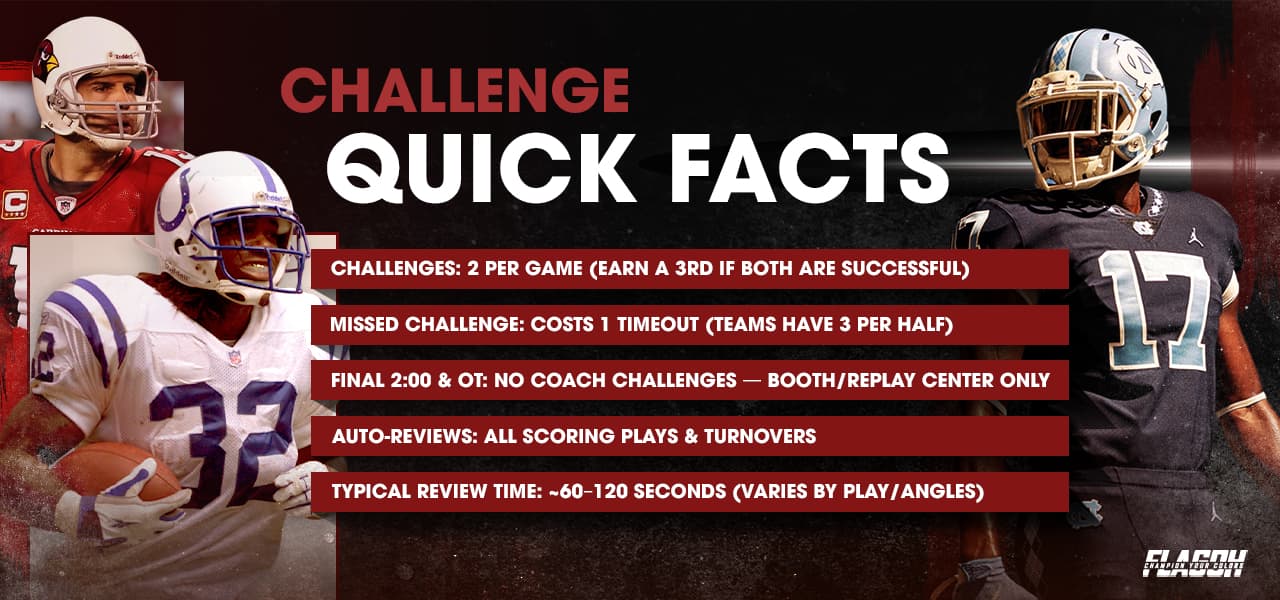
A head coach may initiate up to two challenges per game; a third is granted only if the first two are successful. An unsuccessful challenge costs one timeout (teams have three timeouts per half). The booth initiates reviews during the final 2:00 of each half and in overtime.
At-a-glance
| Item | Value |
| Challenges per team | 2 (earn a 3rd if both initial challenges are successful) |
| Cost if unsuccessful | 1 timeout |
| Two-minute / Overtime | Coach cannot challenge; booth/Replay Center only |
| Auto-reviewed | All scoring plays and turnovers |
| Typical review time | ~60–120 seconds (varies by play/angles) |
What’s Challengeable vs Not?
Before we dive into the “how,” it helps to separate objective rulings that replay can correct from judgment calls that replay won’t touch. This section clarifies who initiates reviews, what can be challenged, and common myths that lead fans to ask, “Can you challenge a flag in the NFL mid-drive?”
Coach’s Challenge vs Booth Review
Pre-conditions (coach’s challenge)
- You must have at least one timeout available.
- The red flag must be thrown before the next legal snap or free kick. “Next legal snap” means the ball is legally put in play; a false start or delay of the game does not close your window.
- If a challenge flag and the next snap appear simultaneous, officials use judgment to decide whether the challenge was timely.
Windows & who initiates
- Coach-initiated: most of the game, outside the final two minutes of each half, and away from overtime constraints.
- Booth/Replay Center-initiated: late-half/OT scenarios and all scoring plays & turnovers (automatic).
Scope & limits
- Replay corrects objective facts (spot, boundary, possession, number of players, clock application). It does not re-officiate judgment (e.g., how much contact equals holding).
- Replay cannot create a new penalty that was never called on the field; it can only correct reviewable elements tied to the ruling.
Standard of proof
- Call changes only with clear, visual evidence.
- Confirmed: video proves the ruling correct.
- Stands: evidence isn’t conclusive either way—on-field call remains.
- Reversed: video proves the ruling wrong.
Reviewable (objective) Examples
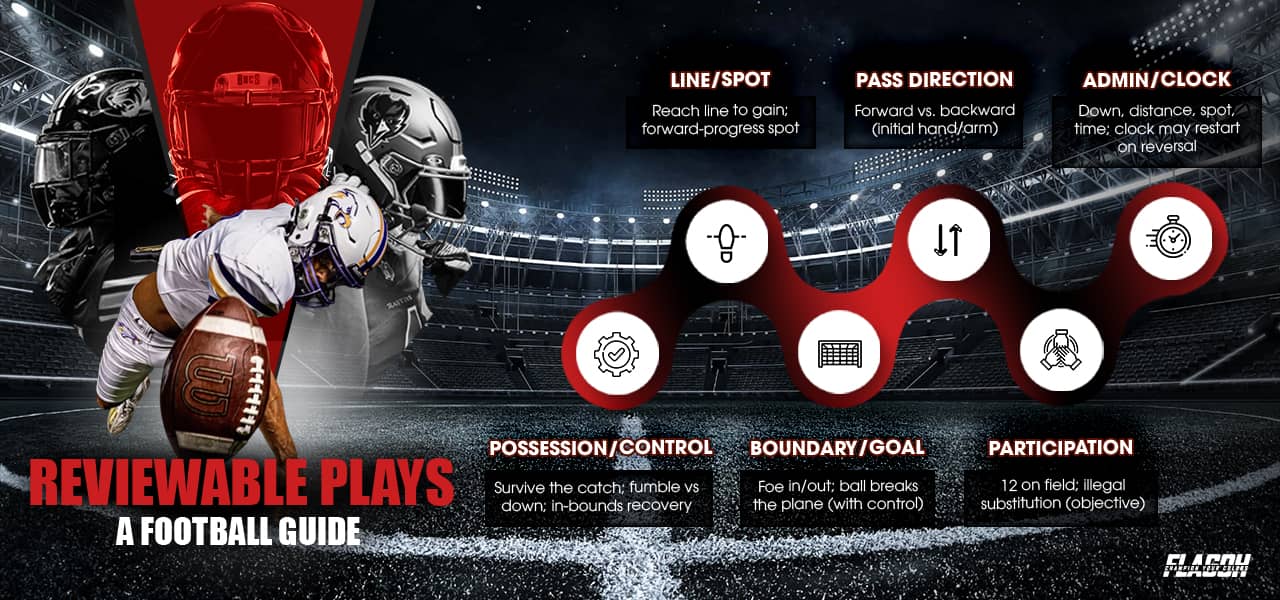
- Possession & control: ball security through the process of the catch, fumble vs. down by contact, recovery in bounds.
- Line to gain / line to gain vs. spot: whether the ball reached the line to gain; forward progress spot at the moment of control/tackle.
- Boundary & goal line: toe drag in-bounds/out-of-bounds; whether the ball broke the plane of the goal line with possession.
- Forward vs. backward pass: initial direction when the passer’s hand/arm is moving.
- Participation count: 12 men on the field / illegal substitution when it’s an objective count, not a subjective “participation” judgment.
- Administrative & clock: down number, distance, spot, time remaining if tied to the reviewed play (e.g., clock should restart on a reversal).
Tip: If the fix requires only a spot/clock correction and the angles are crystal clear, you often get a quick, “expedited” ruling—no need for a long booth conference.
Non-reviewable (judgment) Today
- Judgment fouls: most offensive/defensive holding, most pass interference, illegal contact, roughing the passer, hands to the face, unsportsmanlike/taunting.
- Subjective elements within a reviewable play remain off-limits. Example: you can challenge whether a catch was completed in bounds (objective feet placement), but you can’t use replay to judge hand-fighting along the route as DPI/OPI if no flag was thrown.
- No fishing expeditions: replay won’t scour for unrelated penalties not part of the ruling on the field.
How Many Challenges Flags in the NFL?
Each team begins with two coaches’ challenges per game. League policy provides a path to a third challenge if earlier challenges are successful. To initiate any challenge, a team must have a timeout available, and each unsuccessful challenge costs one timeout.
| Item | Value |
| Standard challenges | 2 per game |
| Earn a third? | Yes—contingent on successful prior challenges |
| Cost if unsuccessful | 1 timeout |
| Timeout prerequisite | Must have at least one available |
Timeout Economics
- What a timeout is worth: early in the game, a single timeout is often worth field position + play-clock flexibility; late in the half or game, it can be worth points (stopping a runoff, preserving 40, or engineering extra snaps).
- Hidden costs: a failed challenge burns one timeout and a challenge opportunity. You also give the opponent extra time to substitute or confirm their next call.
- Practical rule of thumb
- Challenge only if the likely outcome is a material swing (possession, score, 1st down, big field-position change).
- If the best-case gain is a few yards on 2nd-and-10 at midfield, think twice; if it’s a 4th-down spot or a turnover, think “green light.”
Can you challenge in the last 2:00 or in OT?
- Inside the final two minutes of each half and in overtime, coaches cannot initiate challenges; reviews are initiated by the booth/Replay Center.
- Practical implications:
- Get your challenge down before the two-minute warning if you need it.
- After two minutes, focus on clock/communication—the booth will handle reviewable errors.
How to Throw (and Win) a Challenge (HowTo)
Mechanics matter. The difference between saving a timeout and swinging a drive often comes down to crisp sideline operations, the right evidence standard, and timing your red flag to beat the next snap.
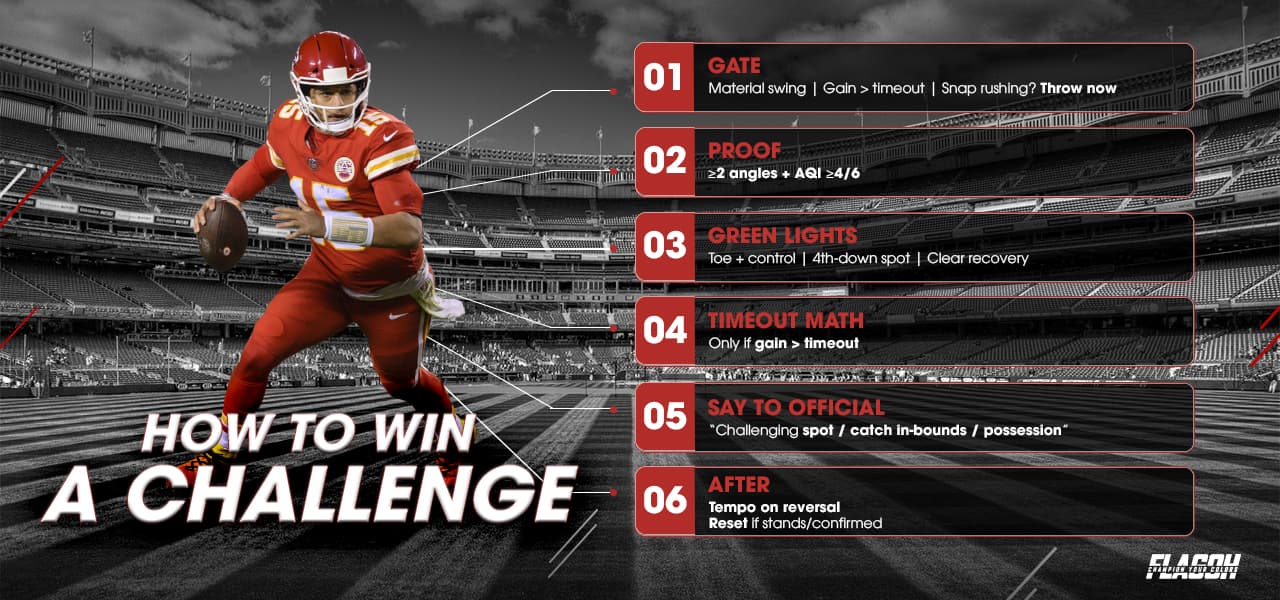
| Module | What to check | Threshold | Do this | Why it matters |
| Decision gate | Material swing (turnover, line-to-gain, goal line, explosive ≥20 yds) | Must be Yes | Consider challenge | Targets play that change the win probability |
| Angle count | Independent replay looks | ≥ 2 clean angles | Green-light | One obstructed view rarely meets the standard |
| Timeout trade | Value of timeout vs expected gain | Gain > timeout value | Challenge | Preserves clock equity late in halves |
| Snap risk | Offense rushing to the line | Imminent | Throw now or abandon | The window closes at the next legal snap |
| AQI quick score | Framing + Stability + Redundancy | AQI ≥ 4/6 | Proceed | Simple, repeatable go/no-go metric |
| Sideline catch | Toe + control clearly visible | Both present | Throw fast | Boundary explosives are high leverage |
| 4th-down spot | Possession hinge | Yes | Prioritize speed | Even ½-yard can flip the ball |
| Turnover scrum | Clear in-bounds recovery | Seen by a spotter | Throw early | Possession + field position swing |
| Call to the official | Name one element | “Challenging spot/catch in bounds/possession” | Keep it single-target | Crew reviews the element you specify |
| After ruling | Outcome management | Reversed: go tempo. Stands/Confirme: move on | Execute ready call or reset | Converts reversal into immediate advantage |
Strategy, Comparisons & Benefit
Knowing the rule is one thing; using it well is another. Here’s how to target high-leverage plays, why other leagues feel different on TV, and how to bring that precision to your own game-day setup.
When a Challenge Is +EV
Leverage, not perfection: Chase swings worth expected points—turnovers, goal-line breaks, 4th-down spots, sideline/end-zone toe-taps on big gains.
Timeout valuation: Late-half timeouts are scarce and powerful; a marginal 7-yard gain rarely beats a timeout with 90 left.
Two cues for “go”:
- You’re reasonably sure the TV angle(s) show what you need (toe down in-bounds, ball across the line).
- The change directly produces a 1st down, a turnover, or points.
Two cues for “no”:
- The benefit is a field position only on early downs.
- You’re down to one timeout with significant clock left.
NFL vs College/XFL/USFL
- NFL: Mixed system—coach challenges most of the game; booth/Replay Center controls late-half/OT and all scoring/turnovers.
- College (NCAA): Primarily booth-initiated reviews; coaches have limited challenge usage.
- Alt pro leagues: Some use a central command center with broader in-game correction authority; transparency and speed can differ, but judgment vs. objective remains the core divide.
Rivalries at home: show both sides—House Divided
Hosting a big game with fans from both sides? A house-divided flag keeps the peace and looks great in photos. Choose a split design that gives equal space to each team’s colors and logos, and make sure the contrast line is clean so both sides pop. Common sizes are 3×5 ft (≈91×152 cm) for porches and tailgates; decide between a pole sleeve for banner poles or grommets for standard flagpoles. For outdoor displays, look for weather-resistant printing and a finish that won’t fade under weekend sun. Pro tip: hang it where cameras catch the split straight-on—your posts will thank you.
Editorial note & game-day gear
We occasionally reference FlagOh Fanatics products; our rule explanations remain independent and accuracy-first. If you’re upgrading your setup, prioritize polyester/nylon in 150D–200D, double-stitched hems, brass grommets, and colorfast/UV-resistant dyes (sizes listed in in/cm, weights in oz/g).
Best practices in the field
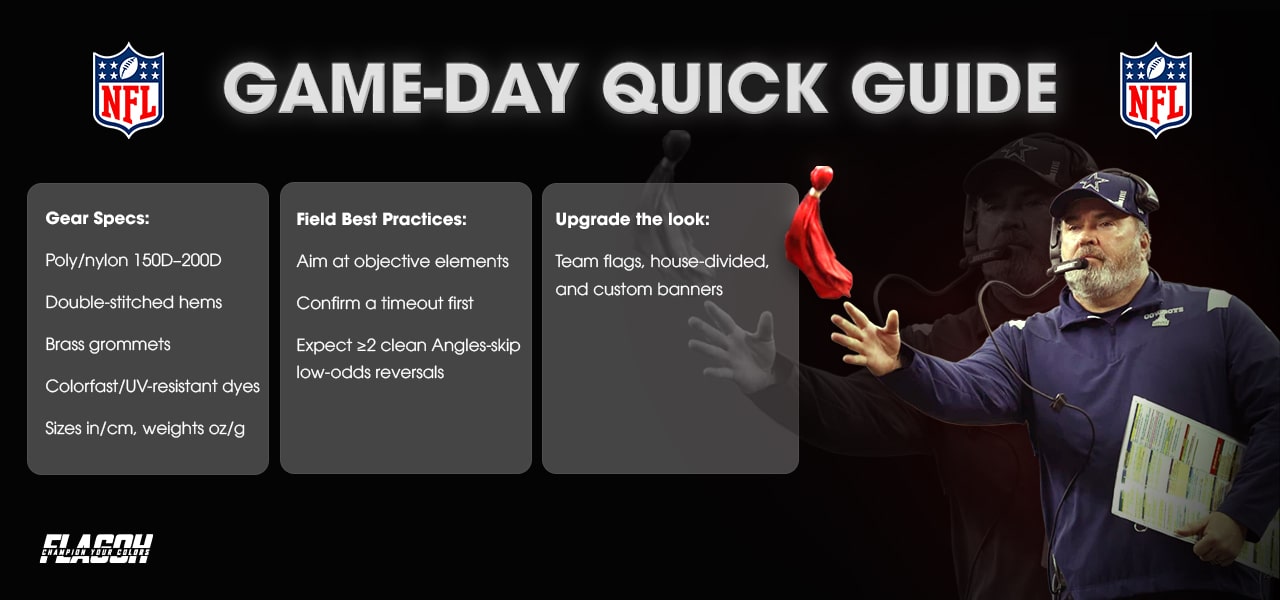
- Aim challenges at objective elements (spot, boundary, player count).
- Confirm a timeout is available before throwing.
- Verify you’ll likely get two clear angles; don’t chase low-odds reversals.
Why it matters
- Protects timeouts, flips possessions, and safeguards points.
Recommendation: Upgrade your look—explore team flags, house-divided, and custom banners at FlagOh Fanatics.
Challenge & Review: Key Questions
Can you challenge a flag in the NFL inside the final two minutes?
No. Inside 2:00 of each half and in OT, only the booth/Replay Center can initiate reviews.
How many challenges do NFL coaches get?
If you’re searching for how many challenge flags in the NFL, the answer is two, with a possible third if the first two are successful.
Does a failed challenge cost a timeout?
Yes—one timeout for each unsuccessful challenge.
Are touchdowns and turnovers challengeable by coaches?
They’re automatically reviewed; coaches typically don’t challenge those.
Can you challenge pass interference or roughing the passer?
Generally, no, they are judgment penalties under current rules.
Can you challenge after the next snap?
No, once the next legal snap occurs, the window closes.
Do you need a timeout available to challenge?
Yes, you must have at least one timeout to initiate a challenge.
What do “confirmed,” “stands,” and “reversed” mean?
Confirmed: video proves the call; stands: not enough evidence; reversed: video disproves the call.
How long do NFL reviews take?
Often ~60–120 seconds, depending on angle availability and play complexity.
Who initiates reviews in overtime?
The booth/Replay Center.
If you’re still asking, “Can you challenge a flag in the NFL”? Remember only three things: challenge objective elements, throw before the next snap, and protect timeouts. For game-day looks that match your rules IQ—team flags, house-divided layouts, or fully custom banners—start at FlagOh Fanatics.