
Curious about the financial reality of the Minor Leagues? One of the most frequent questions we receive at FlagOh Fanatics is simply: how much do Double-A baseball players make? With over a decade of experience covering the business side of the game, we’ve compiled this guide to break down current salaries, benefits, and the real-life economics of the Double-A grind.
Detailed Answer to How Much Do Double-A Baseball Players Make
Before we dive into details, here’s the short version. Most Double-A players now earn four figures per week during the regular season, with minimum salary floors set by the first MiLB collective bargaining agreement. Public reporting shows that the minimum annual pay at this level rose from about $13,800 to roughly $30,250, more than doubling what many players earned just a few seasons ago. At the same time, some sources still quote older weekly figures, which is why you may see numbers that don’t match perfectly. What fans really need is a clear, current picture of pay per week, per season, and around spring training and offseason events. That’s what the next subsections explain, step by step.
Weekly Pay Rates During the Championship Season
A good starting point is the weekly paycheck during the regular season.
- Recent reporting on Double-A and Triple-A players shows weekly pay of around $1,020 at Double-A and $1,225 at Triple-A in 2025 for many players.
- Earlier CBA coverage highlighted a minimum annual Double-A salary of $30,250, which lines up with a weekly rate of a little over $1,000 when spread across the championship period.
That means a typical Double-A player on the minimum can expect something like low- to mid-five figures in base salary for the season, before taxes and deductions.
Here is a simplified example of how that looks in practice:
| Player type | Approx. weekly pay | Estimated weeks paid (in season) | Est. season total (pre-tax) | Est. monthly equivalent* |
| Minimum Double-A player | ~$1,020 | 22–24 | ~$22,000–$25,000 | ~$4,400–$5,000 |
| Solid regular at Double-A | ~$1,100–$1,300 | 24–26 | ~$26,000–$32,000 | ~$5,200–$5,800 |
| Mixed AA/AAA season | ~$1,020–$1,225 | 24–26 | ~$27,000–$30,000+ | ~$5,400–$6,000 |
*Monthly equivalent assumes roughly a five-month championship period. Real figures vary by team, contract type, and time spent at each level.
These numbers sound decent on paper, but remember: this is gross pay, and the checks only cover the championship months, not the full 12-month year.
Annual Salary Expectations Under the New Agreement
Under the first MiLB CBA, the headline was clear: minor league salaries would more than double at many levels. For Double-A, that means:
- Minimum annual salary is around $30,250 at Double-A.
- Some Double-A and High-A players, particularly those with more experience or better bonuses, can earn well over that floor, sometimes reaching into the $40,000+ seasonal range.
Still, when you compare this to full-time work at a modest US salary, the gap is obvious. A typical full-time worker earning $50,000 per year may make more than many Double-A players, and they’re paid over all 12 months, not just the season.
The CBA changed the baseline, but it did not suddenly make Double-A pay “rich” money. It simply pushed salaries closer to a sustainable level.
Compensation for Spring Training and Offseason Events
Historically, many minor leaguers were not paid for spring training at all. The new labour deal changed that.
Some legal and sports-law summaries note payments such as around $625 per week for spring training and about $250 per week for offseason workouts at home, as part of updated compensation structures.
That’s not a huge windfall, but it matters. In practical terms:
- Players are more likely to receive at least some income while preparing for the season, rather than training entirely on their own dime.
- Winter ball, special events, and private lessons can add extra income, but those opportunities vary a lot by player, team, and country.
Essential Benefits That Supplement the Salary
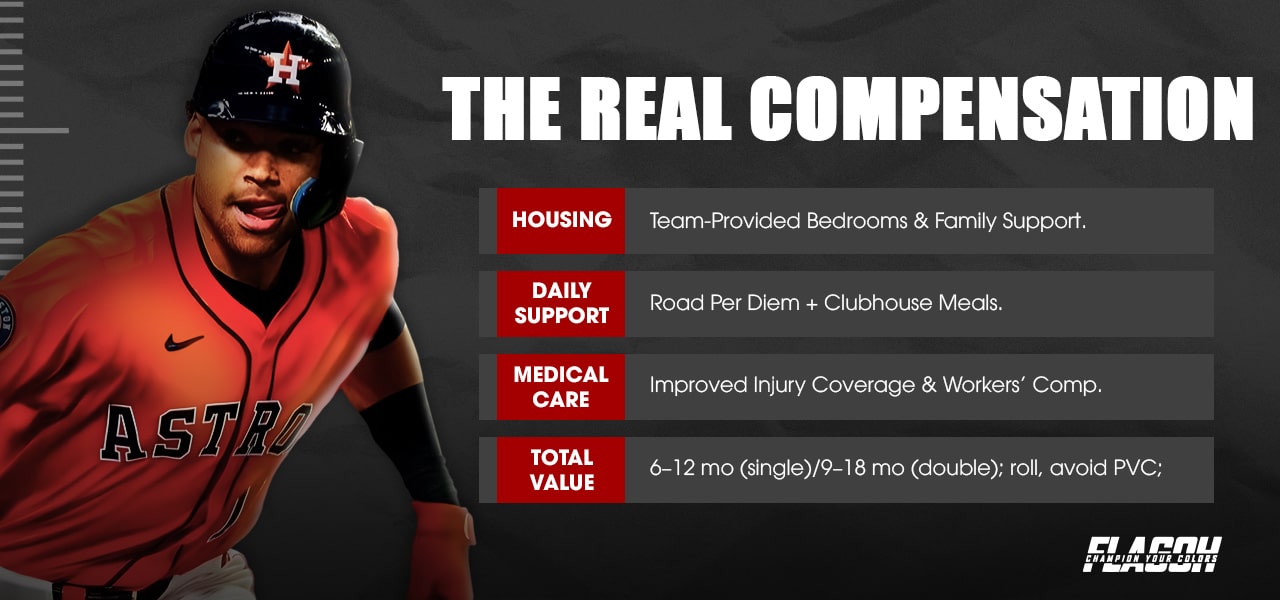
Salary alone doesn’t show whether life at Double-A is truly sustainable. The new MiLB agreement also reshaped housing, daily costs, and medical support, all of which change a player’s real compensation package. When we break this down for FlagOh Fanatics readers, we always highlight that these benefits can be the difference between barely scraping by and just about managing from month to month.
Housing Policies and Accommodation Stipends
Housing was one of the biggest pain points for minor leaguers. Under the newer rules:
- Double-A and Triple-A players are now guaranteed team-provided housing with their own bedrooms, improving both privacy and stability.
- At lower levels, teams must provide housing or a stipend, so players aren’t stuck choosing between unsafe apartments and long commutes.
- Spouses and children are included in these housing plans at the upper levels, which is vital for players with families.
If you’ve ever tried to rent near a ballpark in a busy metro area, you know how big a benefit that is. The effective value of housing can easily reach many thousands of dollars per season.
Daily Meal Money and Per Diem Allowances
On the road, players rely on per diem and team meals so they aren’t buying three restaurant meals a day out of pocket.
Typical perks now include:
- Team-provided clubhouse meals around game time.
- Cash per diem on travel days and road trips, often enough to cover basic meals (exact numbers vary by club and level).
Per diem doesn’t make anyone rich, but when you’re only earning five figures, having food partially covered can be the difference between staying within a budget and going into debt during a long road series.
Healthcare and Retirement Savings Options
The MiLB CBA also improved lifestyle and medical protections for minor leaguers. While the exact details differ by contract, key themes include:
- Better access to medical care and injury treatment reduces the risk of paying large bills out of pocket.
- Clearer rules around workers’ compensation and time on the injured list.
- For players on 40-man MLB rosters, there are separate minimum salary floors (over $60,000 for minor-league time on a major-league contract) that can significantly raise total income compared with a standard MiLB deal.
These protections don’t show up in the weekly pay figure, but they matter a lot for long-term financial and physical health.
Salary Differences Across Minor League Levels
To understand “How much do Double-A baseball players make?”, you also need to see where Double-A sits on the wider MiLB ladder.
Recent reporting and legal analysis of the new CBA show this pattern:
- Complex/Rookie leagues: minimum annual pay around $19,800 (up from $4,800).
- Low-A: minimum annual pay around $26,200 (up from $11,000).
- High-A: minimum annual pay around $27,300 (up from $13,800).
- Double-A: minimum annual pay around $30,250 (up from $13,800).
- Triple-A: minimum annual pay around $35,800 (up from $17,500).
So Double-A is not the lowest level, but it’s still far from the Major League minimum, which is set at $760,000 in 2025 and will rise to $780,000 in 2026. The gap between Double-A and MLB remains enormous, which is why players treat Double-A as both a tough job and a crucial audition stage.
Critical Factors Influencing Total Player Income
Two players with the same listed “Double-A salary” can still end up with very different take-home income. Several big factors shape the final number: taxes, cost of living, offseason work, and roster status. The ideas below are based on typical situations and should be seen as general information, not personal financial advice.
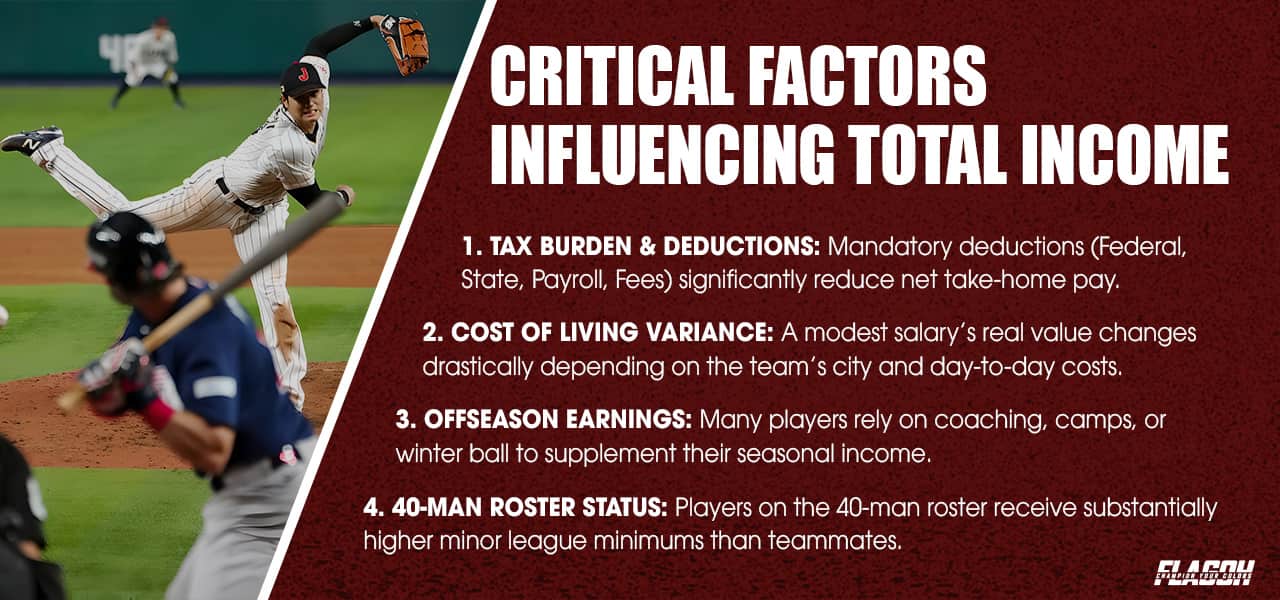
- Taxes and mandatory deductions
- Federal and state income tax.
- Payroll taxes (Social Security and Medicare in the US).
- Possible clubhouse dues, agent fees, and union dues.
A player making around $30,000 at Double-A might see 20–30% of that disappear to taxes and basic deductions, depending on their filing status and where they play.
- Cost of living in the team’s city
- A Double-A salary stretches much further in a smaller city than in a high-rent metro area.
- Even with team housing, day-to-day costs (groceries, car payments, childcare) can drain a modest paycheck quickly.
- Offseason income
- Many players pick up coaching jobs, camps, and private lessons in the offseason.
- Others play winter ball or find short-term work outside baseball.
- A busy offseason can add several thousand dollars per year, while a quiet one adds very little.
- 40-man roster status
- Players on the 40-man roster but still in the minors are covered by MLB minimums for minor-league assignments (over $60,000 per season on first major-league contracts).
- That can more than double what a typical non-40-man Double-A teammate earns.
For families and prospects planning a path through the minors, it’s important to look beyond the headline salary and think about all of these moving pieces.
Common Inquiries Regarding Minor League Compensation
Most fans and parents ask the same handful of questions about Double-A money. To close the loop on Double-A baseball players’ salaries, here are short, clear answers you can rely on.
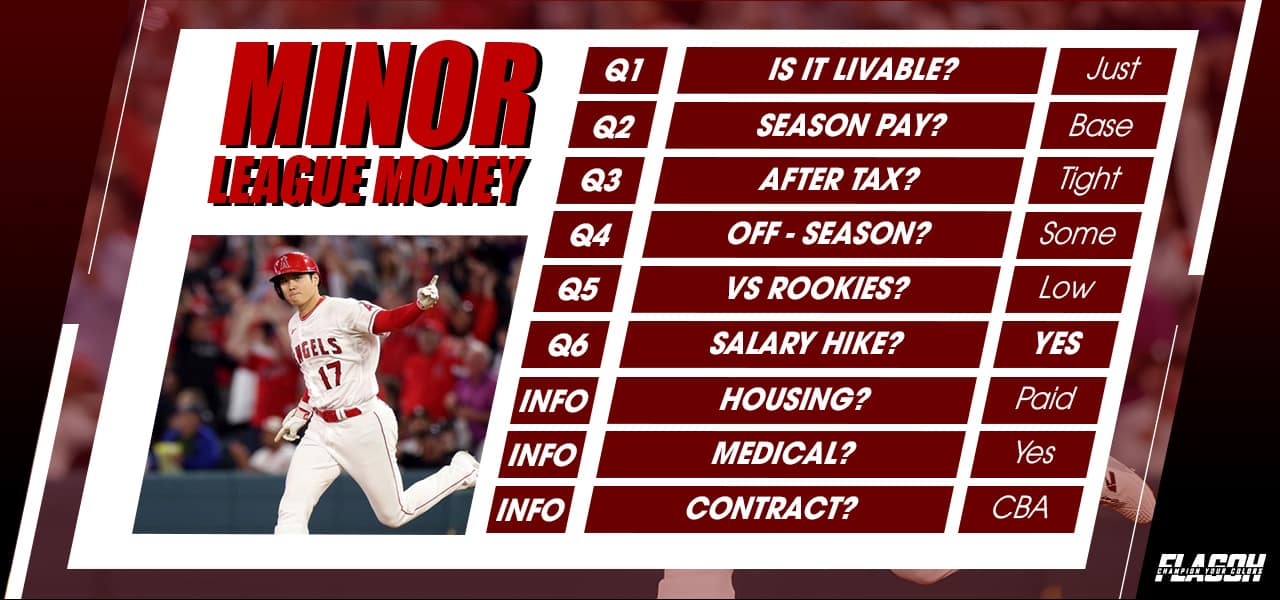
1. Do Double-A baseball players make a living wage?
Players earn more than they used to, and housing and medical benefits are better, but many still sit not far from basic living-wage levels once taxes and everyday costs are taken out. Some can get by; others still need help from offseason work or family.
2. What is the typical seasonal income for a player?
A typical Double-A player might earn somewhere in the mid-five figures for the season, with minimum salaries around $30,000 and many landing a bit above that, depending on experience and time spent at higher levels.
3. How much money is left after taxes and expenses?
There’s no single number, but after 20–30% in taxes and other deductions, plus everyday costs, a player on a $30,000–$35,000 seasonal salary could end up with less than $2,000 per month in “free” cash across the year.
4. Do Double-A players get paid in the offseason?
Under the new labour deal, players can receive some pay for offseason workouts and spring training, but there is still no full 12-month salary for most standard MiLB contracts. Most players need offseason income from other sources.
5. How much do Double-A players make compared to Triple-A or MLB rookies?
Triple-A minimum salaries are a bit higher (around $35,800 per year vs. $30,250 for Double-A), but both are tiny compared with the MLB minimum, which sits in the hundreds of thousands per season.
6. Have Double-A salaries increased in recent years?
Yes. The first MiLB CBA more than doubled minimum salaries at many levels, including Double-A, and improved housing and medical standards as well. Players are still pushing for more, but conditions are noticeably better than they were before 2023.
So, how much do Double-A baseball players make today? Thanks to recent agreements, the baseline is finally closer to a living wage: roughly $30,000 per season, plus housing support and better medical coverage. However, when you factor in taxes and the offseason gap, the financial road remains tough. As a fan, your support means everything. Whether you are buying tickets or waving custom designs from FlagOh Fanatics, showing your colors helps sustain the energy at the park while keeping the reality of the Double-A grind on your radar.