
Counting down to the Battle of the Bricks? Our Ohio Bobcats vs Miami RedHawks primer focuses on what actually shapes your night in the stands—how the rivalry plays, which matchups matter, and how to layer for weeknight MAC weather. With FlagOh Fanatics’ guidance on durable flags, you’ll breeze through gates and stay comfortable from warm-ups to the last whistle.
Ohio Bobcats vs Miami RedHawks matchup review
These two programs often square off in weeknight MAC slots, and the result is usually decided by a few plays. In this FlagOh Fanatics game-day guide to the Ohio Bobcats vs Miami RedHawks, we unpack the rivalry’s context, key player storylines, projected depth charts, and legal viewing options in Eastern Time.
Game State Drivers and Tactical Tendencies
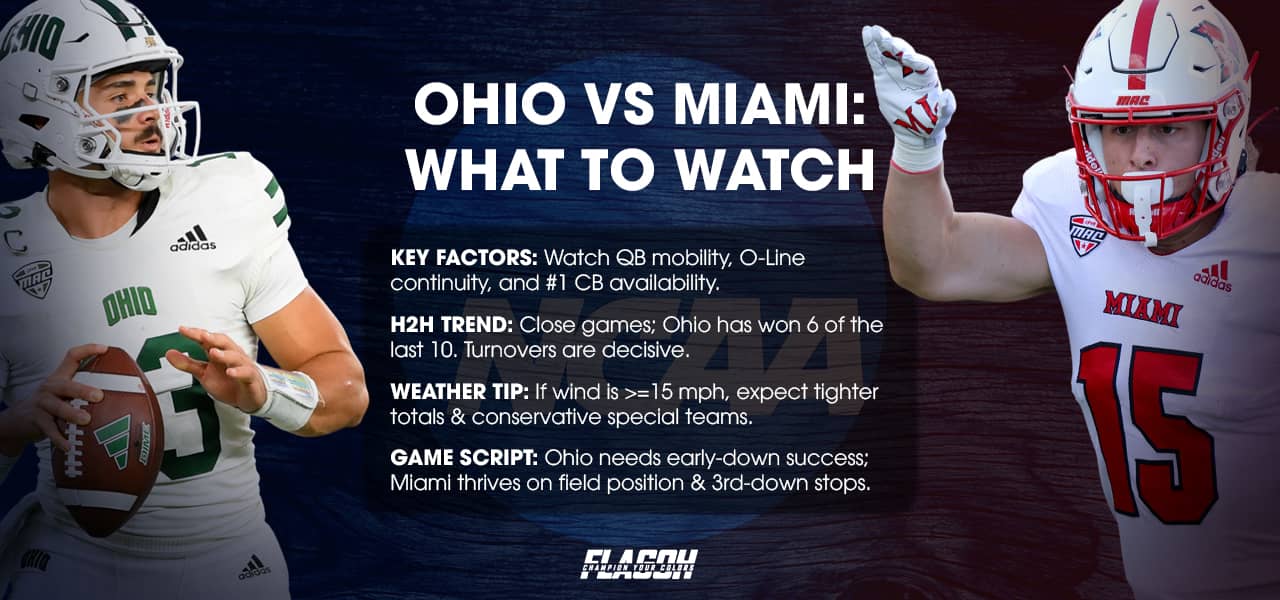
Under weeknight MAC lights, the margin for error shrinks—outcomes typically hinge on:
- Quarterback health and mobility: A fully mobile quarterback changes early-down play calls (more rollouts and option keepers), improves scramble expected points, and stresses the second level. Limited mobility usually means quicker throws and a heavier screen game.
- Offensive line continuity: When the left tackle–left guard pairing stays intact, outside zone and play-action shots are more viable; shuffles or new starters tend to raise pressure rate and shrink the deep passing menu.
- Cornerback No. 1 availability: With a trusted top corner, defenses can live in single-high and spin safeties to the run, capping explosives. Without him, expect more two-high shells and softer cushions on the perimeter.
- Script and tempo: Ohio typically thrives when early-down success rate clears ~45% and drives stay on schedule; Miami’s best versions compress possessions with field-position discipline and third-down stops.
- Special teams and net field position: Punt efficiency, touchback rate, and realistic field-goal range in wind all shape how many short fields each side earns. A 10–15 yard swing in average starting position often flips a one-score game.
Practical takeaway for fans: Layer a mid-weight hoodie (250–350 GSM) under a waterproof shell (≥5,000 mm), bring a stadium cushion for metal bleachers, and pack hand warmers for fourth-quarter chill. If winds project ≥15 mph, expect conservative special-teams choices and tighter totals.
Head-to-Head Profile and What It Predicts
Across the modern sample (2015–2024), the rivalry has produced close, possession-driven games with momentum swings rather than blowouts. Miami holds the historical edge overall, but Ohio has taken six of the last ten, outscoring Miami by roughly a touchdown per game. Totals have been balanced (about half Over, half Under), reflecting how weather and game script tug the number in opposite directions. Three recent meetings turned on late takeaways, underscoring how turnover margin (+1 or better) correlates with the winner.
How to apply this:
- Favor the side winning early downs (staying ahead of the chains) and protecting the ball.
- Expect the market to price totals cautiously in wind or rain; late line moves often track forecast shifts more than injuries.
- If a top cornerback or left tackle is unavailable, anticipate a one-to-two-point drift in spread or total as explosives or protection become shakier.
Special Teams & Starting Field Position
In the football match, small special-teams swings often decide one-score results. Track these live levers and what they imply for the game script:
- Net punt and return phase: A net-punt edge of ~7–10 yards per exchange compounds into short fields over 8–10 possessions. Watch hang time (≥4.5s), punt direction (boundary vs numbers), fair-catch rate, and first-contact depth on returns. If Ohio/Miami pins drives inside the 15 twice, expect the opposing OC to shorten the menu (quicker game, lower total).
- Kickoff strategy and average starting field position: Touchback rate vs into-wind pooches can move the average start line by 4–8 yards. If a team consistently opens at 32–35 while the opponent starts at 25–27, anticipate an incremental scoring lift and more four-down aggressiveness near midfield.
- Field-goal range and fourth-down bands: Track the kicker’s pregame max (where makes are routine vs “needs perfect contact”). Inside the opponent 38–45, coaches choose between a ~50+ yard try, a pin punt, or a calculated go. If wind or surface lowers the probability, expect more fourth-and-short attempts and heavier play-action.
- Penalty discipline and substitution tempo: Pre-snap flags (formation, false start, illegal shift) wipe out hard-earned field-position gains. Clean substitutions on special teams prevent “12 men” calls and rushed protections—the difference between three points and a block.
How to read it live:
If one side stacks a +6 to +10 yard starting-position advantage and wins return EPA (no muffs, two first-contact misses), lean toward that team in a tight Ohio Bobcats vs Miami RedHawks finish. Pair that with a reliable 45–50 yard field-goal range, and you’ve got the profile that closes out MAC weeknights.
Where to watch Ohio Bobcats vs Miami RedHawks
Before you pack, plan the screen. For the Battle of the Bricks rivalry game, FlagOh Fanatics recommends confirming listings in ET (Eastern Time) and using only legal options.
Game details
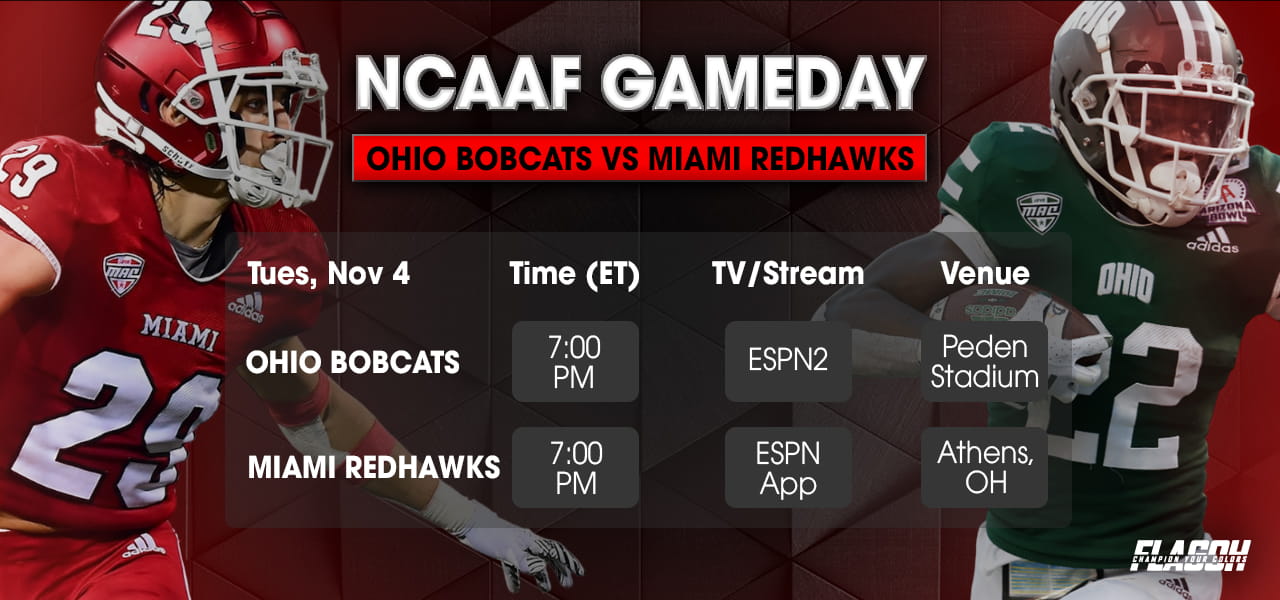
- Date: Tuesday, November 4, 2025
- Time: 7:00 p.m. ET
- Venue: Frank Solich Field at Peden Stadium, Athens, Ohio
- TV: ESPN2 (national)
These specifics are confirmed by both schools and major listings.
TV / Streaming
Watch on ESPN2; authenticated streaming available via the ESPN app or participating providers. Check your live guide in Eastern Time during game week; blackout rules may apply.
Team pages to verify listings
- Ohio Bobcats schedule/news and TV confirmations.
- Miami RedHawks schedule/news and game capsule.
- MAC TV slate and composite schedules for quick cross-check.
Radio & Audio
Each school’s radio network typically carries full pregame, play-by-play, and postgame coverage with live links on the game capsule.
Watch parties
Venues in Athens and Oxford often host audio-on watch parties for weeknight MACtion—call ahead to confirm sound and seating.
Responsible viewing
Use only licensed providers and official streams to avoid malware and piracy issues.
Broadcast & Device Readiness Check
- Log in to your TV provider on the ESPN app beforehand; confirm channel authorization.
- Run a speed test (goal ≥10–15 Mbps for HD); switch to 5 GHz Wi-Fi if possible.
- Prep a backup audio stream (radio feed) and a 10,000 mAh power bank for phones.
Ohio Bobcats vs Miami RedHawks match player stats
Next, we turn trends into on-field edges—helpful whether you’re setting viewing plans or packing the right layers for the Ohio Bobcats vs Miami RedHawks with a little inspiration from FlagOh Fanatics.
Ohio Bobcats Team Analysis
Track success rate on early downs, red-zone TD (touchdown) rate, havoc from the front seven, and explosive pass rate allowed. Expect a clock-control script (bring a warmer mid-layer) if early-down wins are consistent; expect more standing/cheering in a tempo game.
Miami RedHawks Team Analysis
Watch pass-rush win rate, pressure-to-sack conversion, and third-down stop rate—indicators of short fields that can tilt total points. If Miami’s RB (running back) room is banged up, anticipate heavier play-action, which changes possession lengths (and how long you’re in the weather).
Key Positional Matchups & Advanced Metrics
QB vs coverage shells; WR (wide receiver) target share vs man/zone; yards-after-contact for the RB1 (lead running back); and EPA (expected points added) per play deltas when blitzed. These micro-edges often decide one-score MAC games—and what you’ll want on hand (poncho vs beanie, gloves vs hand warmers).
Terminology in 30 Seconds
- Success rate: % of plays meeting yardage goals (staying “on schedule”).
- Pressure-to-sack: How often does pressure turn into sacks? This is the key to totals.
- Havoc: Disruptive defensive plays (TFLs, PBUs, takeaways).
Fan Rally Items & Game-Day Gear
Let’s make your section camera-ready. Here’s how to finish your Ohio Bobcats vs Miami RedHawks look—plus a durable, compliant setup from FlagOh.
Flags & Poles
- Flag: house divided flag, 210D polyester, dye-sublimated, double-stitched fly end for durability.
- Poles: 10–20 ft telescoping aluminum with ~12 mm (0.47 in) grommets; stabilize with ground sleeve or tripod.
- Care: Cold wash, mild detergent, hang dry; rotate to limit UV (ultraviolet) fade.
Quality Assurance: Bench Tests We Run
- Tensile & tear benchmarks: Fabric pull strength ≥ 220 lbf (ASTM D5034) and tongue tear ≥ 12 lbf (ASTM D2261) to resist edge fray.
- Seam integrity: Ball-burst ≥ 70 lbf (ASTM D3787); corner bar-tack survival ≥ 1,500 cycles of snap loading.
- UV & colorfastness: AATCC 16 exposure equivalent to 100+ hours noon sun; ΔE color shift ≤ 2.0 after test.
- Print durability: Dye-sublimation wash cycle (AATCC 61 2A) with no bleed onto header or stitching.
- Hardware corrosion: Salt-spray 48 h (ASTM B117) on snaps and grommets with no red rust or sticking.
- Wind-event simulation: Step gusts 20/25/30 mph; pass criteria = no stitch pop at the fly end and no clip migration.
Materials & Finishing Specs
- Fabric: 210D polyester, weight 115–125 gsm, weave density ≥ 60×60.
- Header: Woven canvas 1.25 in with internal webbing; double row lockstitch.
- Thread: Poly core-spun Tex 40, UV-resistant; 8–10 SPI along hems.
- Grommets: Brass, inner diameter ~12 mm (0.47 in); rolled rim to prevent cut-through.
- Snaps: Stainless or plated brass swivel style to mitigate wrap.
- Print: Sublimation at >300 dpi; edge bleed kept inside hem allowance for clean borders.
Clear-Bag & Essentials
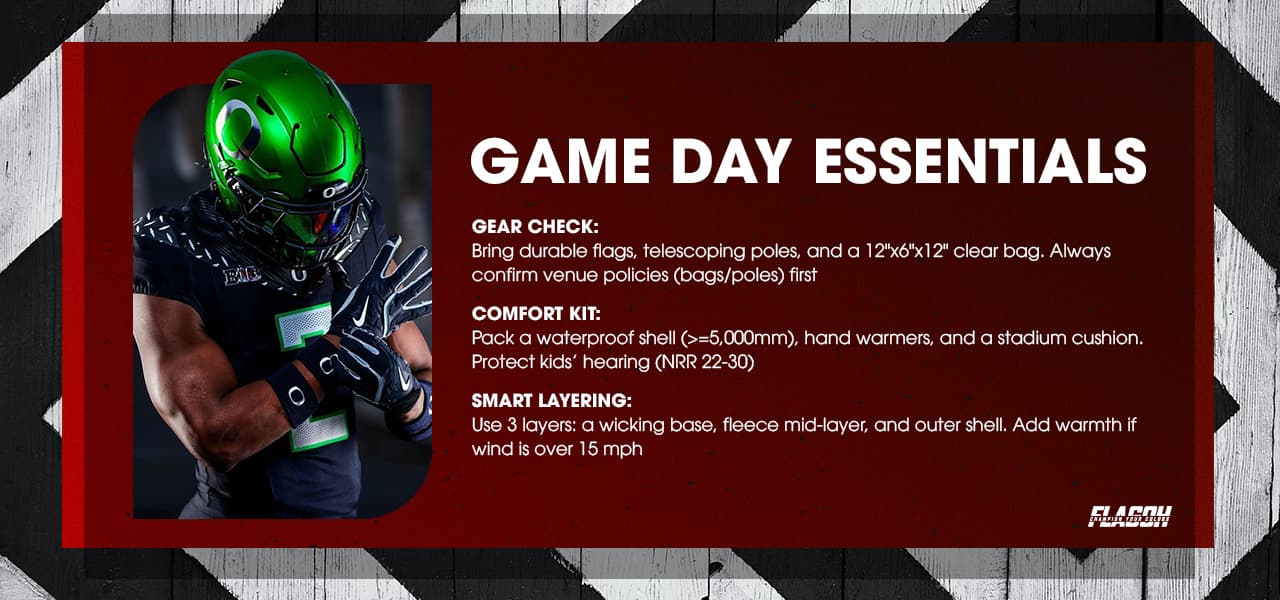
- Policy: Typical allowance 12″×6″×12″ (confirm venue rules on game week).
- Weather kit: Shell ≥5,000 mm waterproof, quick-dry socks, pocket hand warmers.
- Hearing: Kids’ over-ear protection NRR (Noise Reduction Rating) 22–30.
Outfit & Layering Guide
- Base: Moisture-wicking tee 150–200 GSM, long-sleeve if sub-50°F.
- Mid: Fleece hoodie 250–350 GSM.
- Outer: Wind/water shell (≥5,000 mm) with pit-zips for breathability.
Game-Day Adjustments
| Indicator (live/weekly) | If Trending Up | Game-Day Adjustment |
|---|---|---|
| Early-down success (offense) | Longer, controlled drives | Add warmer mid-layer; less concourse movement |
| Pass-rush win rate (defense) | More short fields | Expect louder bursts—ear protection for kids (NRR 22–30) |
| Explosive pass rate allowed | Shootout risk | Extra layer + stadium cushion; more standing/cheering |
| Crosswind ≥15 mph | Kicking volatility | Pack shell (≥5,000 mm); lower one pole section; re-angle guy lines |
Stadium policy reminder: Gate restrictions on poles/banners vary by venue and game designation—check the official page before travel.
Care & Storage Protocol
- Drying order: Rinse dust, hang flat, avoid sharp folds at the fly end.
- Header care: Check bar-tacks; trim loose threads—do not burn ends.
- Mast storage: Collapse sections fully; wipe moisture; separate brass from aluminum to avoid galvanic staining.
- Moisture control: Insert silica gel packets in the storage tote.
Sustainability & End-of-Life Options
- Extend lifespan through corner reinforcement refreshes and snap replacements.
- Retire fabric by down-cycling into banners or practice pennants; recycle metal components where available.
FAQs about the Ohio Bobcats vs Miami RedHawks Game-Day
Quick answers to the questions fans ask most about the Ohio Bobcats vs Miami RedHawks, curated by our team.
What waterproof rating do I need for light to moderate rain?
Look for ≥5,000 mm; for sustained rain or wind-driven showers, step up and add vents/pit-zips.
How do I mount a house divided flag to a telescoping pole safely?
Clip the flag to swivel snaps through reinforced ~12 mm grommets; fully seat a ground sleeve or lock a tripod base; tension two guy lines ~120° apart; in winds >15 mph, drop one pole section and re-angle lines—always keep clear of power lines and walkways.
Are kids’ ear protectors with NRR 22–30 suitable?
Yes—NRR 22–30 is a solid range for stadium noise; ensure a tight seal over the ear.
Where can I listen if I’m driving?
Local radio networks and student radio typically stream pregame and full play-by-play; check stations during game week.
Do stadiums allow flag poles?
Policies vary widely. Many venues restrict pole length or require flags to remain in tailgate areas. Check Peden/Yager policy pages during game week.
What’s the difference between 210D and heavier fabrics?
210D balances weight and tear resistance for stands/tailgates. Heavier denier can be tougher but may flap harder in gusts; use swivel snaps and guy lines to reduce twist and stitch stress. You’re set for Ohio Bobcats vs Miami RedHawks—from matchup context to watch plans and gear that passes the gate. For compliant, durable house divided flags and weather-ready layers, explore rivalry-day picks from FlagOh Fanatics.