Early Super Bowl 2026 predictions are fun because they give you a head start—but they can also trick you into treating July narratives like January truth. One QB tweak, a new play-caller, or a brutal travel stretch can turn a “favorite” into a wild-card coin flip. In this guide, FlagOh Fanatics keeps it grounded: we’ll use early odds as a temperature check, then grade teams on what tends to travel in the playoffs—QB stability, pass protection, pressure defense, and a realistic path to a top seed. (Pro tip from years of preseason forecasting: turnover spikes are noisy, but pressure and protection trends usually tell you the truth sooner.)
Super Bowl 2026 Predictions and Early Odds Analysis
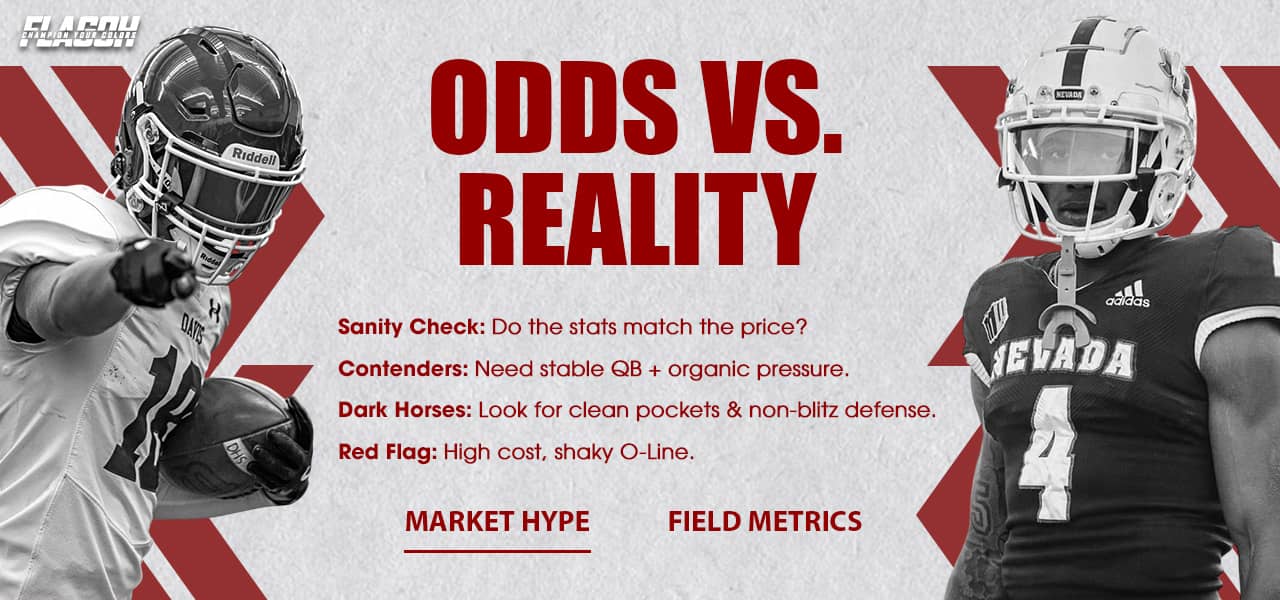
To make these Super Bowl 2026 predictions useful (not just entertaining), we start with the market—then we sanity-check it with repeatable football drivers. Odds aren’t destiny; they’re the crowd’s best guess today, and they’ll move when new information hits (QB health, OL injuries, coordinator fit, and schedule spots).
Method (quick and transparent):
- Market check: odds → implied probability (so we’re not guessing blindly)
- Team scorecard: QB stability + OL protection + pressure defense + explosive-play control + seeding path
- Update rule: refresh tiers weekly, and immediately after major injuries, depth-chart changes, or big line moves
Top Super Bowl Contenders to Watch
Early futures markets punish sloppy football everywhere—not just in one conference. What tends to hold up across the board is the same: stable QB play, pass protection that avoids drive-killing sacks, and a defense that can create pressure without living on high-variance turnovers. That’s why this snapshot combines teams from both conferences: it’s less about labels and more about whether the profile matches the price.
Here’s a simple way to read the board: convert odds into implied probability, then ask one question—does the team’s profile match the price?
- Implied probability (for +American odds): 100 ÷ (odds + 100)
Example: +900 → 100 ÷ 1000 = 10%
Featured Snippet Table: Odds → implied probability (snapshot)
Note: Odds vary by sportsbook and move week to week. Use this format and refresh the numbers on publish day.
| Team (early market leaders) | SB Odds | Implied Probability | Why is it plausible early | The biggest red flag to monitor |
| Los Angeles Rams | +390 | 20.4% | Efficient profile + momentum | Late-season health variance |
| Seattle Seahawks | +750 | 11.8% | Balanced roster, fewer weak spots | Division chaos |
| Green Bay Packers | +800 | 11.1% | QB play + playoff-ready balance | Defensive consistency |
| Buffalo Bills | +850 | 10.5% | Proven ceiling, experienced core | Turnover swings (high variance) |
| New England Patriots | +1000 | 9.1% | Market respects the total roster | Offensive sustainability |
How to use it fast:
- High price + shaky OL = watchlist, not a lock.
- Mid price + stable QB + pressure with four = where early value often shows up.
Leading NFC Powerhouses for Super Bowl LX
The NFC often rewards teams that win “clean.” Less chaos. Fewer self-inflicted losses. When you’re scanning contenders, look for portable metrics (the kind that still matter outdoors, on the road, in playoff pressure):
- Pressure rate (%): Can the defense disrupt without blitzing?
- Explosive plays allowed (%): Can they avoid 20+ yard breaks?
- Points per drive: steadier than raw points early in the year
A quick rule: if a team can win third down without selling out, it’s harder to “scheme them off the field” in January.
Dark Horse Teams That Could Surprise Us
A true dark horse needs a believable “3-step path,” not vibes.
Dark horse checklist (keep it strict):
- QB jump is realistic (decision-making + sack avoidance)
- OL becomes at least average (reduces negative plays)
- Defense can pressure with four (less volatility than blitz-heavy teams)
If you’re tracking early Super Bowl futures all season, dark horses are the most fun—because once the underlying metrics stabilize, a team can jump a tier faster than the favorites.
Where is Super Bowl 2026 Being Held
Super Bowl LX will be played at Levi’s Stadium in Santa Clara, California, on February 8, 2026.
Why it matters for forecasting (small, but real):
- West Coast travel can change routines for some teams.
- The two-week build amplifies media pressure and distraction.
- The crowd mix is often corporate-heavy, so “home vibe” is not the same as a normal playoff game.
Key Factors Influencing the 2026 Championship Race
If you want Super Bowl 2026 predictions that don’t age badly, don’t marry a team in June—marry a process. The fastest way to stay right is to track change drivers: draft roles, free-agency fit, coordinator continuity, and injury clusters (especially at OL/CB). When those inputs shift, your tiers should shift with them—no headline required.

Impact of the 2025 NFL Draft
The draft matters most when it fixes a clear weakness, fast.
Positions that can move a contender the most (fast):
- OT (pass protection): fewer sacks → longer drives → fewer “empty” possessions
- EDGE (pressure): the most reliable way to raise a defense’s weekly floor
- CB (coverage): lowers explosive plays allowed (the quickest points swing)
- QB: massive upside, but hardest to project instantly
Best practice: don’t overreact to highlight reels. Track:
- Rookie snap share (are they actually starting?)
- Whether they improve a measurable weakness (e.g., pressure rate allowed, explosive plays allowed)
A team that upgrades pass protection can “feel” average in September—and become genuinely dangerous by December.
Major Free Agency Moves
Free agency is where fans overpay attention to names. The smarter read is fit + depth.
Two traps to avoid:
- Big signing, wrong scheme → production dips
- One great move, thin depth → injuries expose the roster
What to look for instead:
- Continuity at play-caller (HC/OC stability)
- Two-deep quality (can survive 2–3 injuries at OL/CB?)
- Defense built on pressure + coverage (more repeatable than turnovers)
Preparing for Game Day with FlagOh Fanatics Merchandise
Once your contender feels real, game day becomes a ritual—so build a setup that fits your space and holds up outdoors.

Pick the right size (most common formats):
- Garden flag: 12×18 in, double-sided, sleeve on the short side
- House flag: 28×40 in, double-sided, sleeve on the short side
- Wall flag: 36×60 in, sleeve or grommets on the short side
Many product listings also note that custom sizes are available by request.
Material + durability specs to look for:
- Made with high-quality flax polyester
- Common listing claims include waterproof, weather-resistant, UV-resistant, and fade-resistant
- Double-sided print helps readability, so wording appears correctly on both sides
Best practices (avoid the common mistakes):
- Poles/stands are often not included—match your hardware to sleeve vs grommets before ordering
- In high winds, most damage comes from mounting, not printing—use reinforced hardware and avoid exposure to constant heavy gusts.
Shipping reality check (plan your deadline):
FlagOh Fanatics orders typically print and ship Monday–Saturday, with production times of around 3–5 business days for standard apparel and roughly 5–10 business days for certain custom or handmade items. Some orders may ship separately.
Essential Details About Super Bowl LX
Before we close, here are the quick answers readers always want in one place: date, location, what “LX” means, plus how to interpret early projections without chasing weekly noise. Skim this in 30 seconds, then use it as your reference point as odds and tiers shift through the season.

1. When is Super Bowl LX?
Sunday, February 8, 2026.
2. Where is Super Bowl LX being played?
Levi’s Stadium, Santa Clara, California.
3. What does “LX” mean?
Roman numerals for 60.
4. Are early Super Bowl predictions reliable?
Reliable as tiers, not certainties. Expect shifts after the draft, free agency, and midseason data.
5. What matters most in early forecasting?
QB stability, pass protection, pressure defense, and a realistic playoff path.
6. How do I convert odds into a rough chance to win?
For +odds, use 100 / (odds + 100).
7. When should I trust the data more?
After several games, when roles stabilize and injuries are clearer.
8. How do I update my contender list weekly?
Track QB health, OL injuries, pressure rate trend, explosive plays allowed, and rest/travel spots.
The most useful Super Bowl 2026 predictions aren’t one-time guesses—they’re a living shortlist you can update in minutes. Keep tiers, track the repeatable signals (QB health, pass protection, pressure rate, explosive plays allowed), and don’t be afraid to downgrade teams when the inputs change. When your pick turns into a real run, set the vibe for kickoff with FlagOh Fanatics in the size and mounting style that fits your space.